New apartment standards: what's settled and what's still in court
The Government's new national rules for apartment design took effect on 4 November 2026. The sizes are the same as last year's, but they now stand on firmer legal ground, while a court challenge to last year's rules continues in Europe.
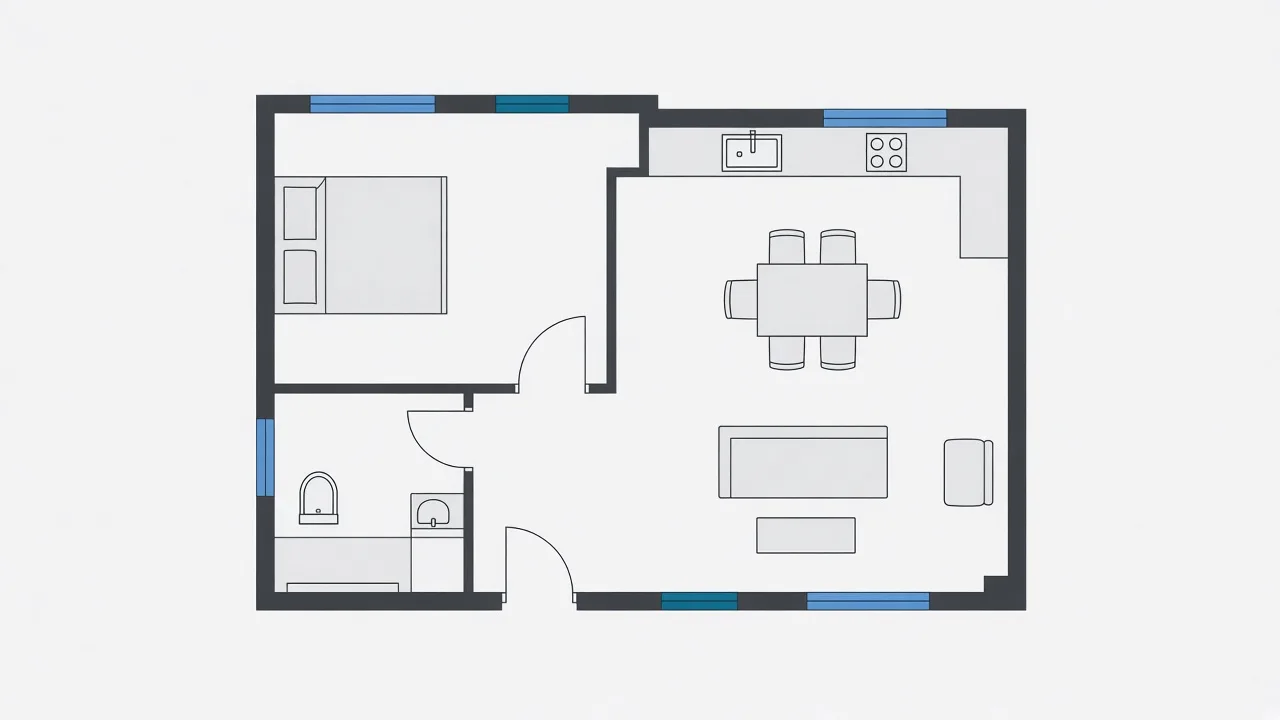
On 4 November 2026 the Government published new national rules for apartment design. The new document is a National Planning Statement, a new type of national policy created by the Planning and Development Act 2024. It applies to every planning application decided after that date.
The apartment sizes themselves haven’t changed since last year. What has changed is their legal standing, and last year’s guidelines are still being challenged in court.
How big does an apartment have to be?
These are the minimum floor areas, measured wall to wall inside the apartment:
| Apartment | Before July 2025 | Now |
|---|---|---|
| Studio | 37 sqm | 32 sqm |
| 1-bed | 45 sqm | 45 sqm |
| 2-bed (3 people) | 63 sqm, rarely allowed | 63 sqm |
| 2-bed (4 people) | 73 sqm | 73 sqm |
| 3-bed (4 people) | not allowed | 76 sqm |
| 3-bed (5 people) | 90 sqm | 90 sqm |
The big changes came in July 2025: smaller studios, more freedom to build smaller two-beds, and a new compact three-bed. The new rules keep all of that.
Two other changes from 2025 also carry over:
- Light and air: at least a quarter of apartments in a scheme must have windows on two sides (known as “dual aspect”). Before 2025, the figure was a third to a half, depending on location.
- Room to spare: a quarter of apartments should be at least 10% bigger than the minimum. Before 2025, it was a majority.
Councils can no longer ask for more. Every council’s development plan used to be able to set its own, higher standards. That is no longer allowed for floor areas or dual aspect. The national minimum is now the maximum a council can require.
Why the rules are now on firmer ground
The 2025 guidelines were binding on councils, but they were not subject to Strategic Environmental Assessment (SEA), the EU-required review of a plan’s likely environmental effects. That is the basis of the court challenge.
The new rules, on the other hand, went through Strategic Environmental Assessment and public consultation. They also carry more legal weight than guidelines did: they override council development plans when planning applications are decided, and every council must now report within two months on how its own plan will be brought into line.
The court challenge
In 2025 a group of applicants took the Government to the High Court over the 2025 guidelines. Their case is that binding national standards like the 32 sqm studio override council plans, and so needed an environmental assessment that they never received.
In February 2026 the High Court sent key questions to the Court of Justice of the European Union and paused the Irish case until it gets answers. It has not struck down the 2025 guidelines, and it has not found the 32 sqm studio or any other standard unlawful.
The new rules have overtaken the case in some ways. They have had the environmental assessment the challenge said was missing, and the guidelines under challenge no longer exist. But some questions are still open:
- whether the new process fixes the problem the challenge raised;
- what the European ruling, when it comes, means for apartments approved under the 2025 guidelines; and
- whether someone will challenge the new rules themselves.
So far, nothing in the case affects planning permissions already granted.
What this means for you
If you are planning an apartment scheme, or have one waiting for a decision, the new rules apply to any decision made after 4 November 2026. Schemes designed to older or stricter council standards may now have room to change their apartment mix. We can help you work out what applies to yours.